
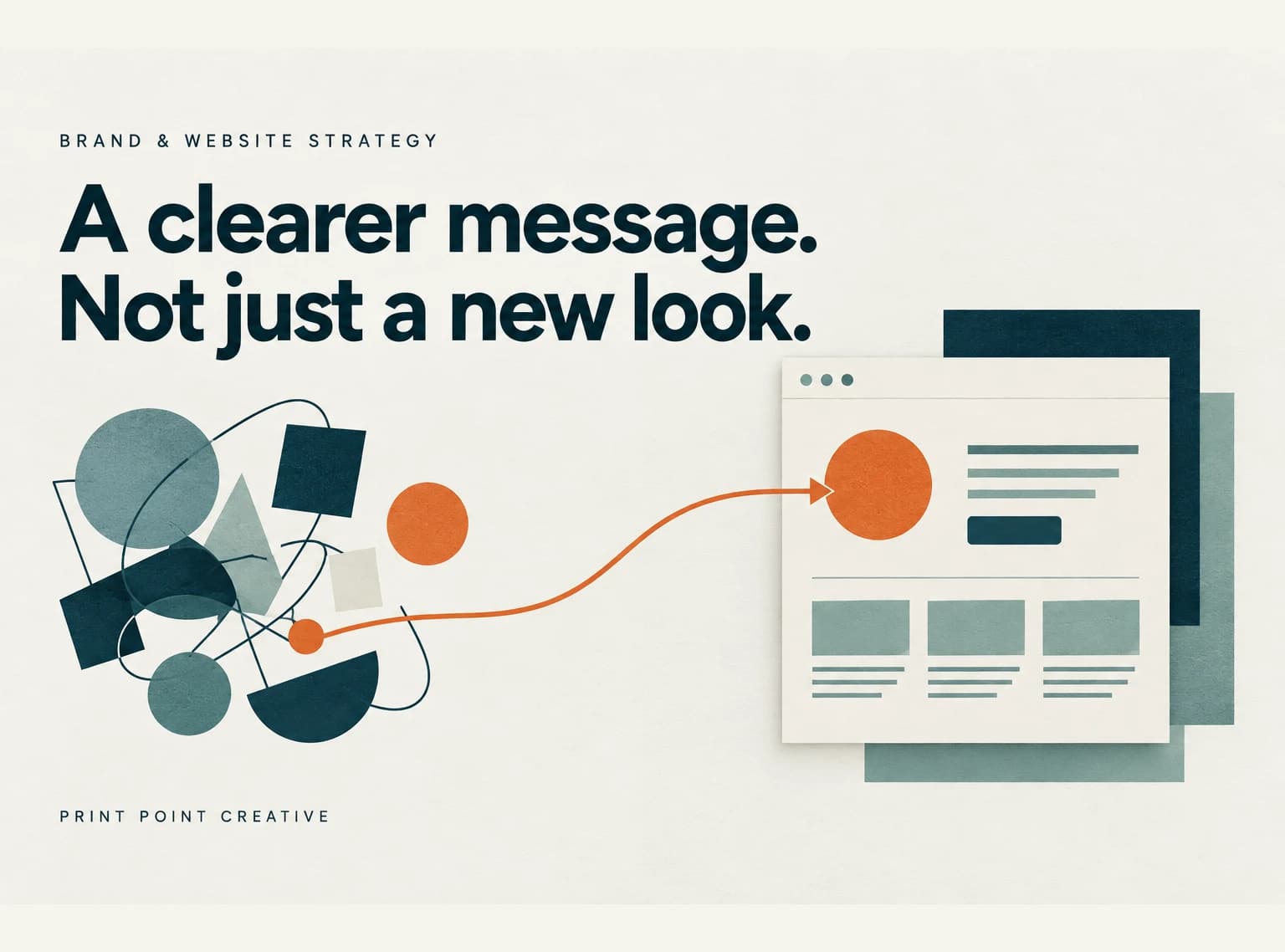
A clearer message. Not just a new look.
You open your website and feel it immediately: this no longer represents the business you are today.
Perhaps the work has become more specialized. Your best clients have changed. Or the services have grown while the homepage still tells the old story.
A new look feels like the obvious next step. Sometimes it is. But before choosing a new layout or colour palette, it is worth asking a less visual question:
Is the website presenting your business poorly—or have you not yet decided clearly enough what it needs to say?
Positioning is the foundation beneath that message: who you help, what they need, and why your business is a relevant choice. When it is unclear, a redesign can make the same uncertainty look more polished.
These five signs can help you decide where to start.
1. Your headline could belong to almost any competitor
“Helping you achieve more.” “Solutions built around you.” “Excellence at every step.”
These phrases sound positive, but they leave visitors to work out what the business actually does. If you could put a competitor’s logo above your headline without changing its meaning, it may not be doing enough.
Try replacing the broad promise with a specific connection between your service and your audience’s situation.
For example, a hypothetical consultancy might replace “Unlock your potential” with “Operational support for growing practices that have outgrown their spreadsheets.”
That is not a universal headline formula. It is a useful test: can someone recognize both the kind of help you offer and the situation that makes it relevant?
Before redesigning: Write one plain-language sentence explaining who you help and what you help them do. Aim for recognition before cleverness.
2. Your services read like an inventory
A business can offer many things and still have a clear position. The difficulty starts when every service gets equal weight and visitors have to assemble the offer themselves.
Imagine a homepage that lists consulting, workshops, training, audits, implementation, and ongoing support. Those may all be useful services. But a prospective client may be thinking, “My team keeps getting stuck as we grow. Where do I begin?”
The website needs to connect those two perspectives.
That could mean grouping services around customer needs, explaining when each option fits, or making the main starting point more prominent. It does not necessarily mean removing services.
Before redesigning: Identify the customer problem each service addresses. Then decide which offer deserves the clearest route from the homepage.
3. Enquiries repeatedly reveal the same mismatch
Some unsuitable enquiries are inevitable. But recurring confusion can be worth investigating.
Are people asking for work you no longer offer? Expecting a quick template when you provide a strategic engagement? Assuming you serve a market you have moved away from?
Those patterns may point to a gap between how you see the business and how the website describes it. They are clues, not proof: referral sources, campaign targeting, and the contact form can also shape who gets in touch.
Review the language and expectations behind recent enquiries before deciding the answer is simply more traffic.
Before redesigning: Note the questions that keep appearing. Look for where your site could explain scope, fit, process, or the next step more clearly.
4. Your strongest evidence supports an older version of the business
Your website says you are a strategic partner. Your portfolio shows only finished visuals. You want more work in a particular sector, but visitors cannot find a relevant example.
The problem may not be the quality of your work. It may be the connection between the work you show and the work you want to win.
A useful case study explains the client’s situation, the decisions made, and what was delivered. Where you have permission and reliable evidence, it can also describe outcomes. Where you do not, clear context is more credible than an unsupported performance claim.
Before redesigning: Choose the projects that best support your current offer. Explain why they matter to the customer you want to reach—not just why you like the finished result.
5. The sales conversation has to correct the website
A good conversation will always add detail. Your website does not need to answer every possible question or close every sale.
But there is a difference between expanding the story and repeatedly correcting it.
If you often begin calls with “We actually do something a little different now,” your website may be describing a business you have outgrown. If different team members explain the offer in conflicting ways, the underlying message may need agreement before anyone writes new page copy.
Before redesigning: Compare the website with the explanation you give a well-matched prospect. What essential context is missing? What promise needs updating? What should remain consistent across both?
A short exercise before you commission a redesign
Complete these four sentences in straightforward language:
We are a good fit for businesses that…
They usually come to us when…
We help them by…
They can trust that approach because…
Make the last answer concrete: relevant experience, a clear process, or work you can show. Avoid relying on adjectives such as “passionate,” “innovative,” or “high-quality” to carry the argument.
Then compare your answers with the homepage. Could a new visitor reach roughly the same understanding without needing you to explain it?
If not, you have a useful starting point for the brief.
Clarity first. Design with a job to do.
None of this means visual design is unimportant. Strong hierarchy, accessible content, thoughtful imagery, and a clear route to enquiry help people understand and use a website.
Nor does every website problem begin with positioning. Slow pages, broken forms, confusing navigation, and inaccessible controls need attention in their own right.
The point is to diagnose the problem before choosing the treatment. You may need a full redesign, a more focused message, or a combination of both. A complete rebrand is not automatically the answer.
At Print Point Creative, we connect brand strategy with website design so the message and the experience work together. The aim is not simply to make the business look different. It is to help the right people understand why it matters to them.
Not sure whether your next step is clearer positioning or a new website? Tell us what feels out of step with your business. You do not need a finished brief to start the conversation.